Human(ism) rules. This is what powers social sciences research, it is the iron that smoothes out the many wrinkles in the onto-epistemological fabric of conventional qualitative inquiry for sure.
is solid assumption is the iron that does not just smooth every wrinkle in the , it makes the fabric . Postqual displaces the human but unplugging the iron
the disturbance that makes postqualitative research not qualitative. It is easier to articulate than to do
You don’t see it coming. You probably couldn’t if you tried. The effects of large changes in scale are frequently beyond our powers of perception, even our imagination. They seem to emerge out of nowhere: the cumulative effects of climate change, the creation of a black hole, the spookiness of quantum mechanics, the societal tipping points reached when the rich have billions rather than millions—even the sudden boiling of water in a slowly heating pot.
More or less of almost anything can change nearly everything.
I’ve been pondering this a lot recently as I watch the explosion of mini-mansions in my once modest Santa Monica neighborhood. A run on teardowns has left older homes looking like abandoned toys wedged between grand new structures straining at the seams of their property lines. They tower into the trees, the better to catch a glimpse of ocean, casting shadows, blocking light.
new neighbors: A mini-mansion highlights the changes happening to a neighborhood in Burbank, California.City of Burbank Community Development Department Visual Preference Survey
I also see a lot more dog poop on the sidewalk, a lot fewer old folks strolling at dusk, a noticeable decrease in the number of “hellos” from the neighbors. More and more owners aren’t from around here; the house down the street is for sale by Berkshire Hathaway. A little money can spruce up a neighborhood. Vast infusions of wealth can turn it into something else entirely.
None of these trends are entirely new. But the phase change I’m seeing shocked even me—and I’ve spent the past 30 years writing about the underlying math and science of precisely how quantitative changes can produce such dramatic changes in quality. My all-too-human intuitions find it hard to accept what physicist Phil Anderson made clear decades ago: “More is different.”
Suppose a woman suffering a headache blames it on a car accident she had. Her story is plausible at first, but on closer examination it has flaws. She says the car accident happened four weeks ago, rather than the six…READ MORE
The realm of the massive is the realm of the round, because gravity crushes everything.
Both $1 million and $1 billion sound like “a lot,” so it’s not immediately clear how such changes in wealth might also change what a builder sees as a “big enough” house. Even those who understand the true scale of the chasm between those numbers intellectually don’t always “get it” viscerally. It feels like the difference between a million and a billion is closer to a factor of three than a factor of 1,000. That’s because our brain naturally works using something like a logarithmic scale, so that it can condense information like vast ranges in loudness and brightness efficiently.
That can get us into trouble—coming to grips with pressing environmental problems, for example. The late physicist Albert Bartlett was concerned that people didn’t fully comprehend the consequences of exponential population growth and the inevitability (and speed) of resource depletion. “The greatest shortcoming of the human race,” he said, “is our inability to understand the exponential function”—that is, change that builds on previous changes. Climate change was able to creep up on most of us with cat feet because it snowballs in the same way, well, as snowballs snowball. Each subsequent change builds on the change before. The bigger it gets, the faster it grows.
Just as our brains have limits grappling with numbers, our senses have limits grasping sizes much beyond our personal, human-sized, scale, where different laws of nature dominate. Flies can walk on walls because gravity at fly scale is a barely perceptible pull, and electrical forces are everything. At the subatomic scales of quantum physics, rules change completely. Particles can be here and there simultaneously; until measured, distance, time, energy, and velocity all exist in a fuzzy state of uncertainty.
Large conglomerations of such particles, however, exhibit none of these behaviors. Our everyday world is made of emergent properties, like color, or people, or thoughts, or music. These qualities don’t exist on the scale of their most fundamental parts. They “emerge” as if out of nowhere when you get enough in one place. Even if you could somehow understand everything about every atom in your cat, you still wouldn’t know if it will purr on your lap or throw up on your carpet (or both).
Big scales are surprising for their own reasons: Where gravity rules, everything begins to look alike. Everyday objects can be square, or pointy, or flowery; but the realm of the massive is the realm of the round, because gravity crushes everything into spheres and disks. Or as the great physicist Phil Morrison so aptly put it: “No such thing as a teacup the diameter of Jupiter is possible in our world.”
Gravity on grand scales gets so bizarre it can trip up the best thinkers. When, almost 100 years ago, Einstein’s own equations of general relativity predicted that a massive enough star could implode into a black hole—leaving nothing behind but an extreme warping of spacetime—he didn’t believe it. You could say he saw black holes coming. But seeing is believing, and Einstein didn’t believe. Which is to say: Predicting the qualitative effects of quantitative changes takes more than mere genius. It takes a willingness to accept the unacceptable—something Einstein did on a regular basis. But this extrapolation went too far even for him.
Considering the trouble our brains have with big numbers and our senses have with seeing much beyond ourselves, it’s not surprising that scaling fools us. But just as Plato used a story about shadows on the wall of a cave to convey how perceptions can trick us, so scientists of today use stories to help us understand scale.
As the poet Muriel Rukeyser put it in The Speed of Darkness, “the universe is made of stories, not of atoms.” For a scientist, it is necessarily both. Scientists often have to come up with stories to translate what they see with their instruments and equations into something they—and we—can understand.
J.B.S. Haldane’s 1928 essay “On Being the Right Size” conveys the limits of our human-sized perspective beautifully, allowing us to vividly imagine how scale affects life—and why giants are impossible. Doubling the height of a person increases her volume (and mass) by a factor of eight; but since the cross-section of her bones increases only by a factor of four, merely standing could be enough to break a leg. The mass of a mouse, by comparison, is small proportional to its surface area; if it falls off a 1,000-yard-high cliff, writes Haldane, it could walk away unharmed. A cat would be killed. And a horse, he tells us, “splashes.”
Physicists certainly needed stories to convey the dangers of nuclear bombs. It was hard to make people see (even today) that they are not simply bigger bombs. They were something qualitatively different—a factor of 1,000 different. Frank Oppenheimer, Rukeyser’s schoolmate and lifelong pal, used the example of scaling up a dinner party in your home. What if you invited four people, and 4,000 appear instead? And you have to make do with the same kitchen, same pots, same glassware? This is a fair comparison, he said, because after all, the Earth itself—the people, the homes, the civilizations—does not change even as firepower increases. The introduction of nuclear weapons brought about a phase change so profound it provoked Einstein to remark: “I do not know with what weapons World War III will be fought, but World War IV will be fought with sticks and stones.”
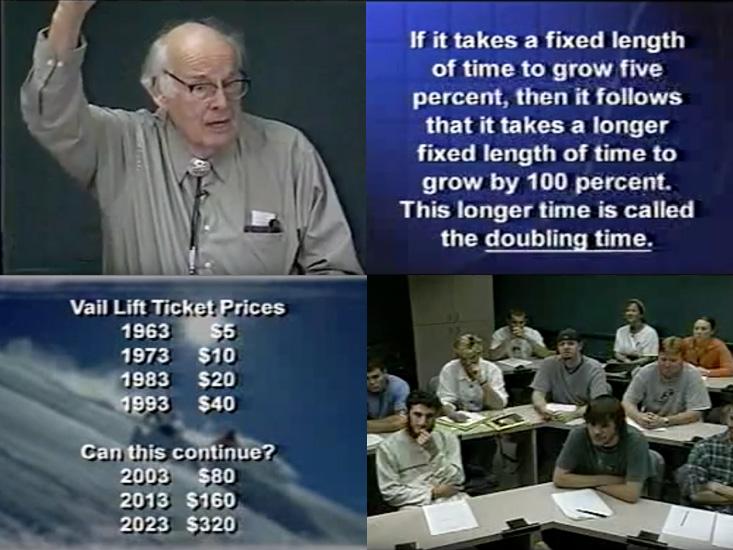
The physicist Bartlett, concerned with resource exhaustion, came up with a story of bacteria living in a Coke bottle. Imagine putting two bacteria in a soda bottle at 11 a.m. Assume the population doubles once every minute, and that by noon, the bottle is full. What time would it be before the bacteria-land politicians noticed that the population was running out of space? The answer is 11:59. After all, at 11:59, the bottle is still half empty! And what if the enterprising bacteria decide to drill for bottles offshore, and bring back three whole new empty bottles! How much time does that give the bacteria? Two more minutes.
doubling time: Albert Bartlett’s Youtube video about the difficulties of understanding exponential growth has been seen over 5 million times. Vail lift ticket prices, one of his examples, continue to grow exponentially.YouTube
In an uncanny case of “science is stranger than fiction,” it appears that real-life bacteria took lessons straight out of Bartlett’s story. That is, certain types of bacteria have developed the ability to cooperatively respond to their surroundings by using what is known as “quorum sensing.” When the bacteria reach a critical local density, they seemingly act in unison to send a signal—to glow with bioluminescence, for example, or start spewing toxic substances into our bodies that can make us very sick. The community knows when a big enough change in quantity has created a qualitatively different environment, even when individuals may not know.
Stories like these have more than mere narrative power. Following the strategy of the bacteria, perhaps social media can be used as a kind of quorum sensing, crowd-sourcing perception. It’s certainly a good way to know when a societal tipping point has been reached, and it makes rapid responses easier. Social media is also a great way to spread stories. A YouTube video of Bartlett telling his exponential growth story has been viewed 5 million times. Multiply that by a factor of even two shares with family and friends (like Bartlett’s bacteria) and you are looking at real impact.
Following the strategy of the bacteria, perhaps social media can be used as a kind of quorum sensing.
Media may already be helping us understand the economic scale changes happening in this country. The surprising success of Bernie Sanders has been propelled by online discussions of income inequality. Michael Konczal, a fellow with the Roosevelt Institute, points out that between 1980 and 2006, gross domestic product increased fivefold, while financial sector profits increased sixteenfold. Between 1984 and 2014, the increases have been fourfold and tenfold, respectively. At this rate, we could well be in for a black hole-sized phase change.
Even billionaires know something qualitatively new is going on here—something so different that the old rules don’t apply. “I’m scared,” wrote Peter Georgescu, chairman of advertising giant Young and Rubicam, in The New York Times recently, speaking of the income gap. “We risk losing the capitalist engine that brought us great economic success.” His billionaire friends are scared too, he said. They know what we’re seeing is not just more of the same.
Could a tipping point exist where a concentrated quantity of power and money really change society? Even individual behavior? The evidence is mounting. One sociological study showed that drivers of more expensive cars are less likely to stop for pedestrians than drivers of less expensive cars. Nobel laureate in economics Daniel Kahneman points to studies suggesting that “living in a culture that surrounds us with reminders of money may shape our behavior and our attitudes in ways that we do not know about and of which we may not be proud.”
We do have a way to “see it coming,” whether it’s environmental tipping points or financial ones. It’s science. The whole point of science is to penetrate the fog of human senses, including common sense. Ingenious experiments and elegant equations act as extensions of senses that allow us to see farther and more precisely—beyond the horizons of what we think we know. Calculations predict possible futures, find clear signals in the almost constant noise.
Science predicted that massive stars would implode, nuclear bombs would explode, and humans could well destroy their own habitat (if they didn’t begin to take seriously problems like overpopulation and resource depletion).
Sometimes science requires us to accept the unacceptable, certainly the unpalatable: What? Drive smaller cars? Give up my lawn? Be satisfied with a small house?
It’s not always fun to see what’s coming, especially when easy solutions are nowhere in sight. It takes courage to admit we’ve been clueless.
Then again, we really have no choice. Bartlett called people who refused to accept they lived in a closed off Coke-bottle-like world the “flat earth society”—because on a flat earth, space could be infinite. There’d be endless amounts of land for farming or garbage dumps, endless supplies of water and fuel, no limit to the amount of toxins we could pump into an infinite atmosphere.
Alas, we live on a sphere. Eratosthenes figured this out thousands of years ago, and no one liked it much then either. But he certainly saw it coming.
A professor at USC’s Annenberg School of Communication, K.C. Cole is the author of the best-seller The Universe and the Teacup: The Mathematics of Truth and Beauty, and most recently Something Incredibly Wonderful Happens: Frank Oppenheimer and his Astonishing Exploratorium.
Research is a risky business: besides the incredibly competitive job landscape for those who want to stay in qualitative field. We are taught that we need to weave an argument. This is why we write lit reviews: to search for what has been done in the past, it is the invitation for the other scholars to back up my idea or reasoning. It is like standing in the academic town square and asking “Who’s with me?”
We write methods section where we articulate how we came to our data, what we plan (or did) with it to analyze, and once again, build a defense.
In the conclusion section, we cover our butts with our limitations. Least someone thinks we think too much of our work.
We are taught to match our language to the language of journals that we want to submit. The price of not heeding this advice is not being published, and without such records, you can not argue that you are the kind of researcher a University want to employ.
Credibility is conceptualized and performed in a systematic manner, that it is a part of the system. I need to play by the rules.
I never was comfortable living within social systems. I refuse to say I am somehow a different, creative thinker, that I march to my own drumbeat in that sexy, fashionable way that became the manifestation of creativity and a welcome to various degrees. My lack of fit has always been accompanied by feelings of inadequacy, the urge to control my contributions out of fear of being laughed, to study and to observe what others are doing, beating myself up for the sincere outbursts of thoughts, checked de facto for appropriatness and further causing insecurity
In January 2019, I attended my first professional conference: TQR. The only session I was able to attend (due to travel arrangements and family obligations) happend to be just before my group and I presented our own work.
I was excited: the panel session was facilitated by several USF professors. And although I personally knew only two of them out six or seven, Bull pride suddenly and inexpectedly washed over me: the presenters and I were from the same academic tribe; my attendance was warranted, but the topic… the topic was simple, even innocent, but strangely captivating: “Who are methodologists and who needs them any way?”
Slowly, but steadily, the question began to resonate with my own two frequencies: the more abstract musings about my emerging academic identity and the ever so real anxities over my future emplyment. Each so intense and demanding of my cognitive resources that it could only occupy my mind one at a time, irreconsilable. The presentation was to be my arbitration.
Reading the first chapter of the “Entangled Beginnings.” OMG, I had to stop and write my first impressions out because her words are so profound. In the first portion of the chapter, as she rounds up her argument about how the Quantum Mechanics Theory is being used in other contexts, such as the play that features the meeting of two famous physicists in Nazi Europe. She makes an importnat disctinction between the purpose of the play and purpose of the actual quantum physics studies. Barad goes on to hypothesize why we as a race are so smitten with QM, and I now totally get it: we simply do not understand it, but are drawn to it because of its potential to explain the numerous messy connection, relations, structures that traditional science and qualitative methods cannot explain. Or even worse, due to political reasons:
“Public fascination with quantum physics is probably due in large part to several different factors, including the counterintuitive challenges it poses to the modernist worldview, the fame of the leading personalities who developed and contested the theory (Einstein not least among them), and the profound and world-changing applications quantum physics has wrought (symboized by the development of the tomic bomb)” p.6.
Because ” The interpretative issues in quantum physics (i.e., questions related to what the theory meansand how to understand its relationship to the world) are far from settled.” p. 6
Barad’s next point about how we just use QM concepts, though we do not even understand them, hits very close to home. This the question of rigor and integrity. This is why I raised my brown at Manning’s (very liberal) use of music theory when she first introduced the Minor Gesture, this is why Hein’s reference to sound as a molecular structure (which he, in turn, seems to have picked up from Deleuze) is misleading. I think in our pursuit of crossing interdisiplinary boundaries we forget to check facts or at least make an attempt to gain some expertise in the field we seek to incorporate in our studies. Great point, Barad!
She next brings forth the problem of analogical thinking that results in “unsatisfactory understandings of the relevant issues” This one cuts me deep because my sense-making strategy is amost exclusively dependent on creating analogies. Guilty as charged, for sure. So how do i change that?
I woke up this morning thinking about my “movie running the background as I think” discovery that I made a week or so ago. This was a lightning bolt type discovery (as almost all my discoveries are, anyway–I think this is what makes me neurotic).
Since then, I asked several other people if they “think in images.” I thought for sure Eddie would say yes because he is an artist, too. But he said no. Yesterday I met a person who thinks visually, like me, in an unlikely place–the front desk of the car dealership. Before she had kids, she went to school to be an artist… I would love to study this thing with her if I ever end up pursuing this research this phenomenon.
So this morning I woke up dreaming (envisioning) myself at a lab, and a participant wearing a sensor cap. I was wondering what technology would allow me to explore what regions of the brain light up when they process language, auditory, sensory, visual information. I am a bit skeptical about this, though: so say, I have the hypothesis that only SOME and not ALL people process information like me. So I would hook up my participants to sensors and have different types of conversations with them: ask them about some episodic memories, discuss a topic new to them (so I could see, if possible, if they use internal imagery to make sense of new concepts), ask them to explain something to me (to see if imagery is involved in their sequential thinking), I would have them watch a movie… and do other things, then analyze the data (which will be collecting information about what regions of the brain are most active during those tasks in different people). The problem is… what if what we know about the mapping of the brain (which parts process what) will change, like the discovery that left and right hemispheres are not involved in different functions, after all. So if I tie my hypothesis testing strategy to the assumption that the brain is processing visual information when it lights up in this particular region, then my research maybe obsolete. Too bad I know so little about neuroscience… I could totally learn more, but how will it affect my objectives now? I could see if a test like this is doable in the Psych department. Gretchen took a class there, so she could tell me more.
So by the time I did the dishes and cooked breakfast, I realized that language would probably be a good tell-tale sign of how the brain is processing information. I hypothesize that a person who is thinking visually will use more descriptive words, that the speech pattern will reflect a lack of direction in a story, but may be very sequential in reasoning (if a person is describing an internal visual concept, she or he will simply describe what he/she sees in no particular order). This thinking will even probably reflect in the type of questions he or she asks because as the person will be asking questions to create a more detailed mental image–this is what “making sense” of something ultimately means–to create a detailed picture or movie as possible so that it will be accessible for further examination or recall at any time. This is why (I suspect) a person who thinks visually takes longer to process and may be asking seemingly useless questions that other people would answer be inferencing. Perhaps, there is an auditory input that creates a distraction or a loop (or serves as one of the major channels of information input; it may be playing a major role in translating information into visual data).
So here are some implications of my discovery: for one, I feel better about myself. For years, I have been trying to find a way to feel “special.” Now I do. For years, I also felt horrible about myself because people thought I was nerdy and they were irritated by the great number of questions I ask. I thought all this was a character flaw. I tried to remedy it by putting my curiosity to good use in the research field, to find redemption, find a niche to fit in, but I now think of all the others who do not have this opportunity. Those who go through life trying to find ways to cope, not embrace their thinking type.
In this version of reality, intelligence tests look like they would be governed not by the Newtonian physics, but quantum mechanics–that is unable to predict or to quantify with any dose of reliability.
What of learning and instruction, too? God forbid anyone misconstrues this as a proof of learning styles theory. I imagine there would be some overlap, but I would not say that I, a visual thinker, prefer to be shown or verbally explained what I do–making an internal image takes ALL modes of input. Hearing uses language which gets processed, then assigned to a visual, then fitted into the larger picture or cast out (which is what creates the confusion). Manual manipulation of things or learning by doing get processed to make the picture richer, more detailed. There does not have to be a preference for any mode–it all goes into the processing grinder to make that puzzle more complete.
I also suspect that everyone thinks visually, but they may not be aware of this. I asked Jenni if she thinks with a “movie running in the background,” and she said no. Yet, she often uses words like “spaces” when she talks about thinking. For example, “I work and think in this space…” To me, it is a totally appropriate way to describe thinking. I often imagine myself roaming a huge mansion where each room is a concept, an activity. I quite literally roam and look in different rooms when I try to make sense of something new. I go through filing cabinets placed in these rooms where my facts and memories are labeled and stored. Funny thing, though, if I were to pull out a memory out of a drawer, I would not end up with an actual object that it visually represents– the picture of the room and the file cabinet would actually dissolve into the new space that gives the recalled concept life–it becomes a new room or a place, only this time, it is not confined to my “mansion” of thought–it transports me to visual memory of this concept. For example, if I thought of Moscow, I’d have a slide show of different visions of Moscow that I obtained from my personal visits, bits that I saw on TV, books, and elsewhere. My personal memories are more vivid because I also use memories of smell, temperature, and other memories of sensory events. I can stretch these memories into a continuous slide, compare different memories but putting them side by side, pull additional images out the stack labeled “Moscow,” interact, visually explore details, make inquiries into other related concepts…
Some this process is not so obvious, it is as if my back is turned to the imaginary screen. Sometimes it feels like I am in a planetarium…. other times, the screen is in front of me. If a conversation is fast, or if there are other sensory events that overwhelm me, the movie is a blur… yet, it always seems to be there, even if it is in shadows…
It would be interesting to record and analyze a verbal account of a thought process of a person blind from birth.
Also bilinguals–I rarely translate from Russian to English. I almost never have to–all information goes in and gets processed visually (even language. If it is a language I do not understand, my brain records the place where my encounter takes place. My language processing channels go into the background mode and get reactivated when I pick up on a word I think is familiar). It all creates a picture anyway even as my mind plays movies of other similar encounters and situations that resemble the one I am currently processing. Comparison of available memories happens simultaneously until I find the closest match or two.
When I speak Russian, my native tongue, the words seem to get translated into imagery seamlessly because my vocabulary is vast. If there is a word I do not know, there is a little hole in the image (similar to a missing jigsaw puzzle piece that is surrounded by other pieces, and therefore, is not always a big deal), or blurred piece. Eventually, the piece is complete and stored. The same happens when I speak English because I have enough vocabulary to create an image of meaning and comprehension (if it is a language I do not know, the image is of the actual event, the place where it is happening). So when I speak to translate, I just translate the image into the other language. The process slows if I did not speak the other language for a while, and cannot find appropriate words. So clearly, expressive and receptive language processes are supported in my discovery the way I see it. Maybe this could be another angle to examine my discovery? To split the concept further?
This could also be an interesting pathway to study autism because it is frequently described as verbal- non-verbal.
Growing up in the U.S.S.R., I heard the word “quality” a lot. To an average Soviet family living in a non-competitive economic environment, “бракованые товары” (defective goods) were a fact of life. Quality was a relevant topic.
My father, a professor of auto-engineering, had similar concerns about quality of education. He often sighed that many of his students were not adequately prepared: they lacked both knowledge and motivation to become the kind of engineers our country needed. I took my father’s comments to heart, feeling anxious: “what if I grow up to be a charlatan?” The thought of disappointing my father, my family, my country, and above all, myself, was painful, so I put my trust in teachers (and later, professors) to teach me all I need to know to become a quality professional. I also found comfort in protocols and methods as I worked to earn my early childhood education, then graphic design, and finally, psychology degrees. I graduated Summa Cum Laude from all three programs, driven by natural love of learning and the fear of being branded a fake.
As a graduate student, I re-examined my fears and questioned my philosophy early in the program. Yet, self-confidence is still stumbling stone. I registered for Interviewing Theory and Practice course as a doctoral student because I recalled my experience in Clinical Interviwing course as an undergraduate psychology undergraduate.
As I progressed through my online psychology program,
I enjoyed The Ghost in Your Genes video and wondered if any new information became uncovered in the decade since it was published. So I searched for recent projects by Professor Pembrey, and came across his editorials that peer beyond the PTSD-like symptoms in children of Holocaust survivors, stress levels of children born to 911 victims or incidence of diabetes in Sweden. Pembrey references studies pointing to fear, muscle memories, social cohesion and cultural continuity, and even choice of friends as but a few of many evolutionary legacies best explained by epigenetics.
In the context of resilience, epigenetics fill an important gap between what we know to be biological, hereditary risk factors and the effects of protective environmental factors, including therapies and interventions. If risk factors can be explained objectively by the patterns and sequences in the molecular chains of nucleotides, then many protective factors are conceptually separated from the risks: until recently, genetics were approached with determinism, while interventions, by definition, work against this view.
Epigenetics bridge the divide because they illustrate how little is determined. If famines can be measured by both the amount of available food and prevalence in diabetes in grandchildren (and vice versa), then we should perceive anxiety, depression, alcoholism, aggression, or any other factor that threatens well-being in the context of generations, and not just family history but looking forward.
On the macro level, the knowledge of epigenetic mechanisms spells the need in policy and even cultural changes on the global level. We should continue to invest money and effort to combat the mental health epidemic of NOW, but knowing what we know about epigenetics, we also must be proactive. For example, we must examine our policies and cultural values and beliefs. It should no longer be just the question of what demands we place on our teachers and students when we ask them to perform at or above certain academic standards; it should also be the question at what price (paid both in currency, as well as physical, and mental health) and who will pay this price for how many generations.
However, I cannot help but wonder: will learning to control genetic switches bring us the happiness we yearn for? Will mental health problems mirror the history of leprosy or say, typhoid fever, as epidemics extinguished by the discovery of effective treatment? Is genetic manipulation the panacea, or a gateway to more problems? Our understanding of resilience came a long way from seeing it as the ability to “pull oneself by the bootstraps” (Daugherty Write, Masten, & Narayan) to discovering risks and protective factors, to creating interventions, and finally, to learning about the genetic factors. With so much more to discover, we certainly have enough to stay busy and to keep imagining what-ifs. Meanwhile, I think resilience is the matter of personal responsibility to self and to others-we are all connected deeper than we think.
(word count: 480)
2. 1:
The subject of resilience fascinates me particularly because I discovered a parallel between the resilience studies and autism research, my personal topic of interest. ASD often co-occurs with anxiety, depression, and other mental health problems that are also present in the resilience discourse. During my recent epigenetics reading escapade, I came across the idea that autism should not be viewed as a disorder, but as a set of risk factors that can either develop further or diminish, depending on the environment and support. Thus, the module devoted to epigenetics in the context of resilience opened new horizons for my academic development, and I plan to read about this topic further.
2. 2:
I appreciated the overview of resilience field development, and was very interested in the types of studies and designs that informed each stage. For example, longitudinal designs that helped extract the list of protective and risk factors and provide an eagle view of developmental timeline for a more comprehensive understanding of the resilience phenomena. Similarly, I enjoyed reading about experimental studies that guide the design of interventions. The lesson on epigenetics pointed out the need for phenomenological designs. If our biology can change in response to what is happening around us, then our lived experiences are important sources of clues to how these genetic switches operate. I think the key here is not just what is happening, or when, or where, or for how long, but our subjective experiences of these events.
2.3:
I thought the discussion of various definitions of resilience was interesting and helpful. I admit I started with a view of resilience as a personal quality that is either present or absent in each individual. I think I perceived resilience as the ability to “suck it up and keep going.” This view was nurtured by my native culture because growing up, I felt the burden of personal obligation to persevere for the greater good of the society. Our class discussions and readings helped me evaluate alternative views and to expand my understanding of resilience beyond my culture-informed defaults. Therefore, our last class, when we discussed individualistic/collectivist societies in the context of resilience, was a natural reinforcement of what I now perceive resilience to be. Needless to say, I really enjoyed the topic of individualism/collectivism because I have experience living in both cultures, so class materials helped me externalize some of the