Haraway keeps reminding: it matters what stories tell stories, what descriptions describe descriptions, and so forth.
I am going to put on trial (where the Committee will be the jury, I will be the person on trial and the Judge, and my dissertation will be a collection of documents, exhibits, etc).
I want to examine the Neoliberal Academy as a system (maybe fall back on General Systems Theory, Theory of Chaos, and also with sympoietic and autopoietic systems the Haraway describes in ch. 1) where thinking differently is suffocated by obsessions with predicting the future, the illusion of control, and the inevitable fatalistic, futuristic, deterministic rationalisms that send the crowds into either Apolcalyptic mood, or belief in some god, be it technology, science, religion, or anything else.
I will put on trial my future (ironic!) as a methodologist–either to answer Kuntz’s call to become a “responsible methodologst” (and whether such endeavor is even possible), or to find a way to exist in the present system.
You don’t see it coming. You probably couldn’t if you tried. The effects of large changes in scale are frequently beyond our powers of perception, even our imagination. They seem to emerge out of nowhere: the cumulative effects of climate change, the creation of a black hole, the spookiness of quantum mechanics, the societal tipping points reached when the rich have billions rather than millions—even the sudden boiling of water in a slowly heating pot.
More or less of almost anything can change nearly everything.
I’ve been pondering this a lot recently as I watch the explosion of mini-mansions in my once modest Santa Monica neighborhood. A run on teardowns has left older homes looking like abandoned toys wedged between grand new structures straining at the seams of their property lines. They tower into the trees, the better to catch a glimpse of ocean, casting shadows, blocking light.
new neighbors: A mini-mansion highlights the changes happening to a neighborhood in Burbank, California.City of Burbank Community Development Department Visual Preference Survey
I also see a lot more dog poop on the sidewalk, a lot fewer old folks strolling at dusk, a noticeable decrease in the number of “hellos” from the neighbors. More and more owners aren’t from around here; the house down the street is for sale by Berkshire Hathaway. A little money can spruce up a neighborhood. Vast infusions of wealth can turn it into something else entirely.
None of these trends are entirely new. But the phase change I’m seeing shocked even me—and I’ve spent the past 30 years writing about the underlying math and science of precisely how quantitative changes can produce such dramatic changes in quality. My all-too-human intuitions find it hard to accept what physicist Phil Anderson made clear decades ago: “More is different.”
Suppose a woman suffering a headache blames it on a car accident she had. Her story is plausible at first, but on closer examination it has flaws. She says the car accident happened four weeks ago, rather than the six…READ MORE
The realm of the massive is the realm of the round, because gravity crushes everything.
Both $1 million and $1 billion sound like “a lot,” so it’s not immediately clear how such changes in wealth might also change what a builder sees as a “big enough” house. Even those who understand the true scale of the chasm between those numbers intellectually don’t always “get it” viscerally. It feels like the difference between a million and a billion is closer to a factor of three than a factor of 1,000. That’s because our brain naturally works using something like a logarithmic scale, so that it can condense information like vast ranges in loudness and brightness efficiently.
That can get us into trouble—coming to grips with pressing environmental problems, for example. The late physicist Albert Bartlett was concerned that people didn’t fully comprehend the consequences of exponential population growth and the inevitability (and speed) of resource depletion. “The greatest shortcoming of the human race,” he said, “is our inability to understand the exponential function”—that is, change that builds on previous changes. Climate change was able to creep up on most of us with cat feet because it snowballs in the same way, well, as snowballs snowball. Each subsequent change builds on the change before. The bigger it gets, the faster it grows.
Just as our brains have limits grappling with numbers, our senses have limits grasping sizes much beyond our personal, human-sized, scale, where different laws of nature dominate. Flies can walk on walls because gravity at fly scale is a barely perceptible pull, and electrical forces are everything. At the subatomic scales of quantum physics, rules change completely. Particles can be here and there simultaneously; until measured, distance, time, energy, and velocity all exist in a fuzzy state of uncertainty.
Large conglomerations of such particles, however, exhibit none of these behaviors. Our everyday world is made of emergent properties, like color, or people, or thoughts, or music. These qualities don’t exist on the scale of their most fundamental parts. They “emerge” as if out of nowhere when you get enough in one place. Even if you could somehow understand everything about every atom in your cat, you still wouldn’t know if it will purr on your lap or throw up on your carpet (or both).
Big scales are surprising for their own reasons: Where gravity rules, everything begins to look alike. Everyday objects can be square, or pointy, or flowery; but the realm of the massive is the realm of the round, because gravity crushes everything into spheres and disks. Or as the great physicist Phil Morrison so aptly put it: “No such thing as a teacup the diameter of Jupiter is possible in our world.”
Gravity on grand scales gets so bizarre it can trip up the best thinkers. When, almost 100 years ago, Einstein’s own equations of general relativity predicted that a massive enough star could implode into a black hole—leaving nothing behind but an extreme warping of spacetime—he didn’t believe it. You could say he saw black holes coming. But seeing is believing, and Einstein didn’t believe. Which is to say: Predicting the qualitative effects of quantitative changes takes more than mere genius. It takes a willingness to accept the unacceptable—something Einstein did on a regular basis. But this extrapolation went too far even for him.
Considering the trouble our brains have with big numbers and our senses have with seeing much beyond ourselves, it’s not surprising that scaling fools us. But just as Plato used a story about shadows on the wall of a cave to convey how perceptions can trick us, so scientists of today use stories to help us understand scale.
As the poet Muriel Rukeyser put it in The Speed of Darkness, “the universe is made of stories, not of atoms.” For a scientist, it is necessarily both. Scientists often have to come up with stories to translate what they see with their instruments and equations into something they—and we—can understand.
J.B.S. Haldane’s 1928 essay “On Being the Right Size” conveys the limits of our human-sized perspective beautifully, allowing us to vividly imagine how scale affects life—and why giants are impossible. Doubling the height of a person increases her volume (and mass) by a factor of eight; but since the cross-section of her bones increases only by a factor of four, merely standing could be enough to break a leg. The mass of a mouse, by comparison, is small proportional to its surface area; if it falls off a 1,000-yard-high cliff, writes Haldane, it could walk away unharmed. A cat would be killed. And a horse, he tells us, “splashes.”
Physicists certainly needed stories to convey the dangers of nuclear bombs. It was hard to make people see (even today) that they are not simply bigger bombs. They were something qualitatively different—a factor of 1,000 different. Frank Oppenheimer, Rukeyser’s schoolmate and lifelong pal, used the example of scaling up a dinner party in your home. What if you invited four people, and 4,000 appear instead? And you have to make do with the same kitchen, same pots, same glassware? This is a fair comparison, he said, because after all, the Earth itself—the people, the homes, the civilizations—does not change even as firepower increases. The introduction of nuclear weapons brought about a phase change so profound it provoked Einstein to remark: “I do not know with what weapons World War III will be fought, but World War IV will be fought with sticks and stones.”
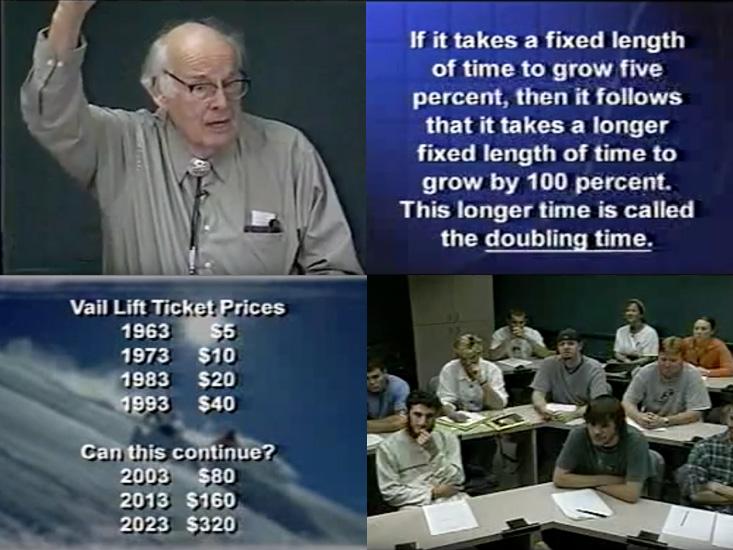
The physicist Bartlett, concerned with resource exhaustion, came up with a story of bacteria living in a Coke bottle. Imagine putting two bacteria in a soda bottle at 11 a.m. Assume the population doubles once every minute, and that by noon, the bottle is full. What time would it be before the bacteria-land politicians noticed that the population was running out of space? The answer is 11:59. After all, at 11:59, the bottle is still half empty! And what if the enterprising bacteria decide to drill for bottles offshore, and bring back three whole new empty bottles! How much time does that give the bacteria? Two more minutes.
doubling time: Albert Bartlett’s Youtube video about the difficulties of understanding exponential growth has been seen over 5 million times. Vail lift ticket prices, one of his examples, continue to grow exponentially.YouTube
In an uncanny case of “science is stranger than fiction,” it appears that real-life bacteria took lessons straight out of Bartlett’s story. That is, certain types of bacteria have developed the ability to cooperatively respond to their surroundings by using what is known as “quorum sensing.” When the bacteria reach a critical local density, they seemingly act in unison to send a signal—to glow with bioluminescence, for example, or start spewing toxic substances into our bodies that can make us very sick. The community knows when a big enough change in quantity has created a qualitatively different environment, even when individuals may not know.
Stories like these have more than mere narrative power. Following the strategy of the bacteria, perhaps social media can be used as a kind of quorum sensing, crowd-sourcing perception. It’s certainly a good way to know when a societal tipping point has been reached, and it makes rapid responses easier. Social media is also a great way to spread stories. A YouTube video of Bartlett telling his exponential growth story has been viewed 5 million times. Multiply that by a factor of even two shares with family and friends (like Bartlett’s bacteria) and you are looking at real impact.
Following the strategy of the bacteria, perhaps social media can be used as a kind of quorum sensing.
Media may already be helping us understand the economic scale changes happening in this country. The surprising success of Bernie Sanders has been propelled by online discussions of income inequality. Michael Konczal, a fellow with the Roosevelt Institute, points out that between 1980 and 2006, gross domestic product increased fivefold, while financial sector profits increased sixteenfold. Between 1984 and 2014, the increases have been fourfold and tenfold, respectively. At this rate, we could well be in for a black hole-sized phase change.
Even billionaires know something qualitatively new is going on here—something so different that the old rules don’t apply. “I’m scared,” wrote Peter Georgescu, chairman of advertising giant Young and Rubicam, in The New York Times recently, speaking of the income gap. “We risk losing the capitalist engine that brought us great economic success.” His billionaire friends are scared too, he said. They know what we’re seeing is not just more of the same.
Could a tipping point exist where a concentrated quantity of power and money really change society? Even individual behavior? The evidence is mounting. One sociological study showed that drivers of more expensive cars are less likely to stop for pedestrians than drivers of less expensive cars. Nobel laureate in economics Daniel Kahneman points to studies suggesting that “living in a culture that surrounds us with reminders of money may shape our behavior and our attitudes in ways that we do not know about and of which we may not be proud.”
We do have a way to “see it coming,” whether it’s environmental tipping points or financial ones. It’s science. The whole point of science is to penetrate the fog of human senses, including common sense. Ingenious experiments and elegant equations act as extensions of senses that allow us to see farther and more precisely—beyond the horizons of what we think we know. Calculations predict possible futures, find clear signals in the almost constant noise.
Science predicted that massive stars would implode, nuclear bombs would explode, and humans could well destroy their own habitat (if they didn’t begin to take seriously problems like overpopulation and resource depletion).
Sometimes science requires us to accept the unacceptable, certainly the unpalatable: What? Drive smaller cars? Give up my lawn? Be satisfied with a small house?
It’s not always fun to see what’s coming, especially when easy solutions are nowhere in sight. It takes courage to admit we’ve been clueless.
Then again, we really have no choice. Bartlett called people who refused to accept they lived in a closed off Coke-bottle-like world the “flat earth society”—because on a flat earth, space could be infinite. There’d be endless amounts of land for farming or garbage dumps, endless supplies of water and fuel, no limit to the amount of toxins we could pump into an infinite atmosphere.
Alas, we live on a sphere. Eratosthenes figured this out thousands of years ago, and no one liked it much then either. But he certainly saw it coming.
A professor at USC’s Annenberg School of Communication, K.C. Cole is the author of the best-seller The Universe and the Teacup: The Mathematics of Truth and Beauty, and most recently Something Incredibly Wonderful Happens: Frank Oppenheimer and his Astonishing Exploratorium.
…writing reads is their affective relationality in terms of what a body, in this case a body of writing, can do. For Spinoza this is a fundamentally important question: What can a body, any body, do? Multiple examples and considerations of this question, rather than what does something mean when it says, p.7
On page 66, the bit about microscope inspired me to think how tools defined the early man. This is an interesting direction to pursue–timeline, of course, is definitely at odds with Kuntz’s criticism of time and space as being stable entities. Would make a good satirical piece, though.
What makes me curious is how toolification until this chapter was the symptom of neoliberal academia, but is it?
I continue to question the topic of neoliberal rationslism as the reason for all that is not right and well with our scholarship and education.
The industrial age began because technological advance–tools were invented and became the condition for progress.
I signed my contract for 20 hours of work in the lab and in CORE. It came with a condition that I am enrolled 9 graduate hours. And so I thought I had only one class left to take–design of systematic studies. The rest could be direct research, and so I went on a hunt for a class that is both interesting and online or offered in AM (I promised Eddie this will be the last semester of him rushing across two counties home so I could be at school by 5).
First, I skimmed painting and drawing offerings–no luck. This would have been perfect! Then I considered a course from Adult Ed. This would have been a sensible choice, yes. But it just sounded like another class. Then I found Symphonic Literature course and sent an email to Jenni right away to see if my committee will approve. She said do it.
The next day I sent an email to the Music professor, Dr. Robison and we had a couple of back and forths about the content of the course and whether I have what it takes to get a good grade. There were a couple of thoughts of a philosophical nature tangled up with the logistics, and when we arrived at the conclusion that this class is a good fit for what I am trying to do, he agreed to issue me a permit.
Overjoyed, I sent an email to Jenni and Janet, and Janet replied the same evening (and copied Dr. Robison even though I sent my little report just to Jenni and her) with and encouragement and a little praise for me. Dr. Robison did not expect that because he felt the urge to reply and to acknowledge how well-supported I am.
The next morning Janet sent us another email. She addressed him “John” even though she never met him, and invited him (and me) to speak at her ABR class this fall. I felt like I was listening on a conversation between my dad and my teacher–when we moved when I was in first grade, my dad went to my new school with me to convince the teacher to let me join her class. Her class was full, and she gave my dad a hard time complaining how she already has so many students, but took me in in the end. I was standing there in the hallway, sweat dripping down my back (it was already late October, radiators were on), wondering what my fate will be. From my lower-to-the-ground perspective (I was short even for my age), the grown-ups were big and important and equals. I felt important too since my dad was advocating for me.
This memory reminded me of this conversation between Janet and Dr. Robison, and me. None of the negatives, but rather, the feeling of being important enough to be the topic of a conversation. The trust in Janet and her support. The moment of standing at a threshold, the feeling of potential–then it was almost a physical sensation, now it is thoughtful acknowledgement.
What really moved me to record this here, is the assumption in Janet’s invitation to her ABR class: Janet, an academic, reached out to Dr. Robison, another academic, ASSUMING he would be interested in joining his scholarship with ours. Unless, of course, Janet read up on him and knew exactly who she was inviting. It could be a little bit of both. Janet is very opportunistic in every best sense of the word–this is what makes her so amazing to watch at work! So it is possible she simply grabbed the bull by its horns. In this case her assumptions make a really interesting case study for analysis. If she did read Dr. Robison’s CV, then her email certainly takes on a different, not any less interesting angle of how interdisciplinary is performed, for example.
For now, I will stash this and add it to the many other notes of this sort on performing the academic.
My first encounter with the word “methodologist” happened when I was young, barely twenty years old. I was standing in front of a three-person jury responding to a question at my final oral exam. I was about to graduate from a small teaching college in the Russian Far East with a degree in early childhood education. One of the examiners, a professor from a much larger, regional pedagogical college, seemed impressed and invited me to further my studies in her program. She prophesied my success a methodologist, a person who planned lessons, procured toys and didactic games, kept current on State educational policies and innovations in preschool pedagogies, and trained teachers. Plainly put, I would be responsible for bridging theory and practice, and the allure was there: I loved children, but struggled to keep order in my classroom. A position as a thoughtful, caring teacher support seemed a wonderful alternative. But my mind’s eye was already fixed on a new challenge–I wanted to learn English. So less than two years later, I boarded a plane to Florida. The term methodologist sank to one of the darker corners of my consciousness where it remained as I trained in graphic arts, worked as a designer, had family, went back to school to earn a B.A. in psychology and finally, chose to study research methods and evaluation as a graduate student.
Research is a risky business: besides the incredibly competitive job landscape for those who want to stay in qualitative field. We are taught that we need to weave an argument. This is why we write lit reviews: to search for what has been done in the past, it is the invitation for the other scholars to back up my idea or reasoning. It is like standing in the academic town square and asking “Who’s with me?”
We write methods section where we articulate how we came to our data, what we plan (or did) with it to analyze, and once again, build a defense.
In the conclusion section, we cover our butts with our limitations. Least someone thinks we think too much of our work.
We are taught to match our language to the language of journals that we want to submit. The price of not heeding this advice is not being published, and without such records, you can not argue that you are the kind of researcher a University want to employ.
Credibility is conceptualized and performed in a systematic manner, that it is a part of the system. I need to play by the rules.
I never was comfortable living within social systems. I refuse to say I am somehow a different, creative thinker, that I march to my own drumbeat in that sexy, fashionable way that became the manifestation of creativity and a welcome to various degrees. My lack of fit has always been accompanied by feelings of inadequacy, the urge to control my contributions out of fear of being laughed, to study and to observe what others are doing, beating myself up for the sincere outbursts of thoughts, checked de facto for appropriatness and further causing insecurity
In January 2019, I attended my first professional conference: TQR. The only session I was able to attend (due to travel arrangements and family obligations) happend to be just before my group and I presented our own work.
I was excited: the panel session was facilitated by several USF professors. And although I personally knew only two of them out six or seven, Bull pride suddenly and inexpectedly washed over me: the presenters and I were from the same academic tribe; my attendance was warranted, but the topic… the topic was simple, even innocent, but strangely captivating: “Who are methodologists and who needs them any way?”
Slowly, but steadily, the question began to resonate with my own two frequencies: the more abstract musings about my emerging academic identity and the ever so real anxities over my future emplyment. Each so intense and demanding of my cognitive resources that it could only occupy my mind one at a time, irreconsilable. The presentation was to be my arbitration.
This was my first conference ever. The “Methodolosts: Who needs them?” presentation was my first and only session I was able to attend. It was an excellent experience, and I am glad I made it.
Methodologists… who needs them? The title meant to stimulate thought and to incite a debate. It accomplished both. People argued and framed the discussion around another question: What is the purpose of research? Is it about answering the research questions, or about asking them? If we can answer that, then we can answer who methodologists are and maybe even figure out who needs them
In me, the presentation stirred up pride: as one of the USF tribesmen, I was thrilled to see so many people come hear what the leaders of my qualitative clan had to say. I loved the tour into their thinking headquarters and appreciated the invitation to think with them. I could not be more pleased!
Yet, I also felt like a homeowner who discovered cracks on the stucco and opened her eyes to the reality of a possible sinkhole. I WANT to be a methodologist, but the ground on which this vision stands is apparently shaky, and so I felt frustration, and a fear of uncertainty for my future.
I know some people in the room were just as conflicted about their thoughts on the matter. Others immediately picked a camp. On the drive back, my co-presenters and I reflected on the experience and even argued a little bit. One student expressed her discomfort with the presentation because it brought USF’s dirty laundry out for everyone to see. It made her feel vulnerable and irate. I disagree–transparency in education is important.
I am still reflecting.
Thirty years ago, my 4th grade teacher called me a “class advocate” for sticking up for troublemakers. This was not meant as a compliment. Ten years ago, a very close friend called me a contrarian, and I agree–I love a good debate. Yet, as my husband frequently points out, I like to argue both sides. He finds it frustrating; I, on the other hand, believe this is how I make sense of things. Some people argue to prove they are right. To them, having a winning opinion is important. I argue because the process helps me to organize information retrieval, to weigh facts, and eventually to arrive at a conclusion or another argument. I could care less whether I prove anything to my opponents: opponents are just helpers, anyway. Of course I like being right, but I enjoy the process of sense-making even more. I am no advocate, I am a discoverer. So how does this relate to the question of who needs methodologists?
Well, I argued every side I could come up with. I enjoyed the stimulation. I also loved the chance to demonize our neo-liberal education and the conditions it creates (it appears I am more of a socialist than I think. Oh wait. I was actually born and bred one, although I cannot say I hate the capitalism entirely–otherwise, why am I here, in the U.S.? Sigh…clearly, it is complicated.) I loved playing “find the label” because it is an exercise in identification of ideological oppression and a chance to analyze linguistic phenomena (I am thinking Derrida).
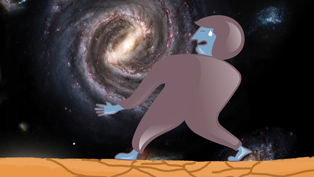
Then I read this article and it occurred to me I do not have to be a social microbiologist all the time. Apparently, astronomers get to have fun, too! In fact, swapping a microscope for a telescope sounds like a welcome change of a perspective. From humans to aliens, just like that…
Conclusion:
I sense the question “who needs them?” promotes the neo-liberal order because it is built using the language of demand and supply. This certainly explains Manning’s shift from major to minor (gesture) I felt while contemplating the topic. It soured my inquiry with fear, and I did not care for the shift.
…or maybe the person who suggested that methodologists know whether they are methodologists was correct? I wonder… perhaps, for many of us this presentation was about an identity crisis rather than the utility and purpose of research, as Johnny Saldana had me believe at first. Is it appropriate, then, to conclude that our post-presentation exchange in the room was the product of a generational (in academic, not chronological sense) divide?