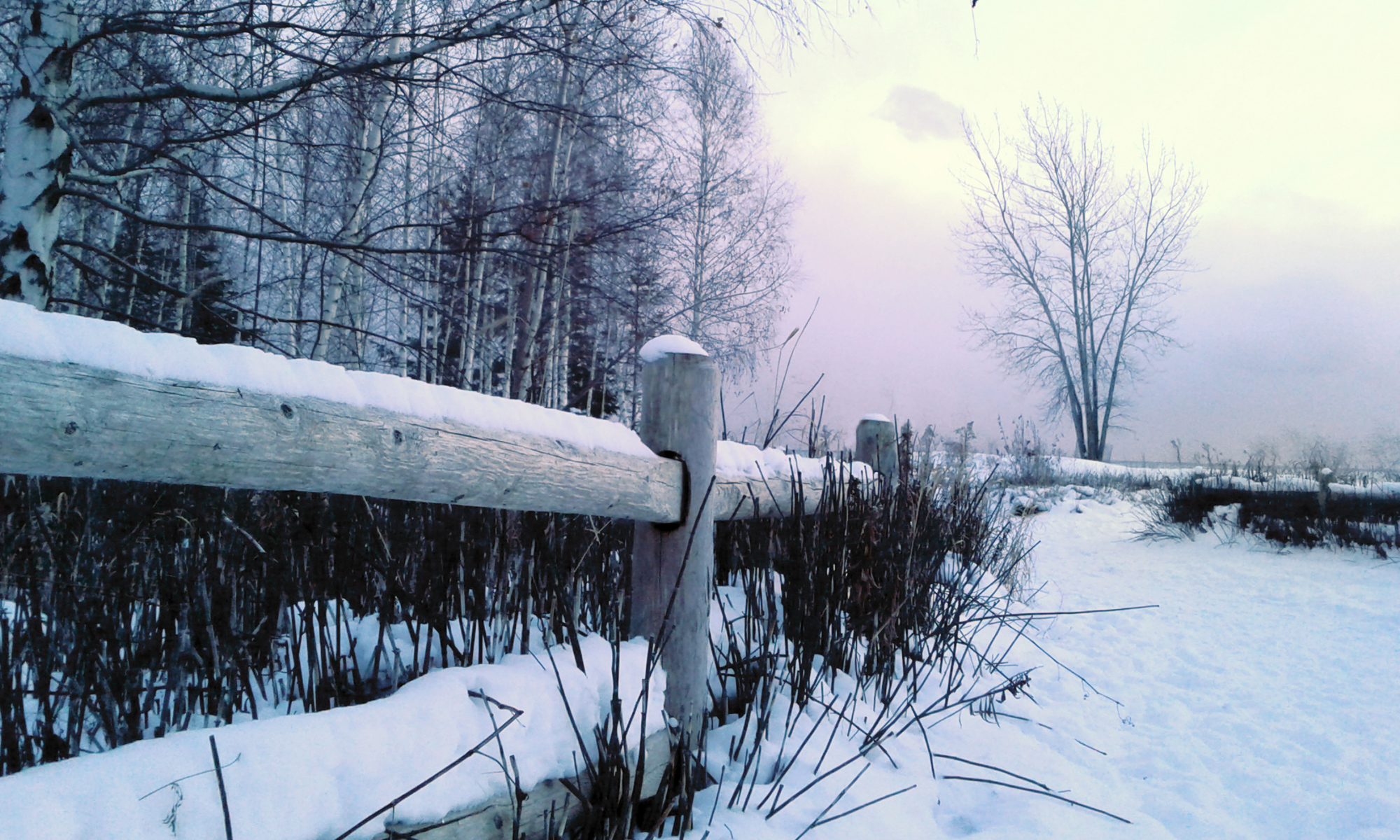
The world of my childhood is black and white. Like the new snow and the black coal in the zinc pail scooped for our furnace at home. …and the black soot on the white bricks of the furnace wall. “Black and white” sometimes even smells like smokey, crisp, frosty winter air. My childhood world is black and white like the birch trees with their soft, smooth, flaking bark–birches are my favorite trees. My childhood world is black and white like my school uniform aprons and hair ribbons–black for daily wear, white for special occasions–and like my black valenki sliding on the smooth, slippery white winter sidewalk. My childhood world is black and white like the freshly lime-painted white pavers and bottoms of black tree trunks–the last Saturday before Mayday people all over the country, young and old, came out of their apartments to clean up parks, playgrounds, and other common areas, to plant trees, to welcome spring, and to connect in a meaningful way. I like the energy that black and white create together.
Yet, my childhood world is also grey. Not because it was not exciting. It is unfortunate that people associate grey with fatigue or boredom. I get it–rainy or snowy days are grey; they are wonderful for napping, but greys induce plenty of other feelings, too. In my childhood, there were a lot of greys. Greys were everywhere. Some of my favorite greys accompany the earliest of memories, like the dark grey lines, curves, and angles created by the graphite of Koh-i-Noor pencils. My favorite of the family is HB. The HB is used most frequently and it is perfectly in the middle–not too soft, not too hard, just right. Bs are richer and deeper, almost black, but they smudge easily. F and H are neater, allow for more precision and thinner lines, but they also scratch drafting vellum if you are not careful. These scratches make the ink bleed when you later outline, and the line comes out imperfect, fuzzy. These pencils were some of my favorite objects to see on my father’s desk: they were important tools if not weapons–my father taught auto-engineering at the Politech, drafting came with the territory. His Koh-i-Noors were always ready to go, peeking from the heavy cast iron pencil holder shaped like a solder’s boot. They were sharpened by my father’s skilled, sure hand with his trusty surgical scalpel, a souvenir from his fourth appendicitis-related surgery. I borrowed Dad’s scalpel to sharpen my pencils since I was young. I hate dull or broken pencils; and yep, I will still take Koh-i-Noors over any other brand any day–quality, soft smooth wood, easier on my sore thumb red from pressing hard on the scalpel blade and dark grey from the graphite dust. At the time, I had no idea Koh-i-Noor made colored pencils and other art supplies, too: Soviet stores in the mid-80s were no exemplars of retail assortment, and Koh-i-Noor pencils were imported in limited quantities from a fellow Soviet Bloc country, Czechoslovakia.
The grey concrete of our new 9-story highrise. My family lived in an old multi-family wooden house with no indoor plumbing until I was six. The Soviet government distributed apartments through professional unions, and my father finally got his turn after many years of being on the Institute’s waitlist. The brand new grey stairs leading up to the seventh floor, the best spot on Earth; four apartments every two flights of stairs. The elevator is not yet working. Young grey concrete whipped into shape by the Soviet builders smells like excitement, happiness, and payoff after many years of using communal outhouses and showers, cooking on the furnace, making water runs in all kinds of weather to the neighborhood pump sometimes frozen solid by the frigid winter temperatures of the Soviet Far East. Grey is a very happy color, full of potential, life, new beginnings.
…The grey soft thin sweater my mother gave me for my fourteenth birthday; I loved it–it complemented my eyes. She knitted most of our winter clothes, but this one she bought. My brother teased it was the same color as mice, as in vermin. But I like mice, no offense here, and since I am on the subject of cute animals, grey is also the color of my pet hamster Homka and my soft, warm winter hat (or was it a coat?) made of rabbit fur. I feel the twinge of moral and cognitive dissonance (Breslavs, 2013) as I pair such contrasting examples of roles animals play in my life in the same sentence–one is a beloved pet, the other is a nameless bunny bred and murdered for its skin. Yet, I remind myself about survival, and the moral discomfort lifts.
…My eyes are grey, as are my father’s and my brother’s. My mother’s eyes are hazel, and I love them, but for some reason, I am more drawn to grey; perhaps, because it is more common then hazel. Safety in numbers, they say.
Grey is a calm, neutral color, but it is full of visual potential-it plays well with others; it complements and softens stark contrasts of black and white borders; it grants flat objects dimensions by simply defining their shadows. It becomes surprisingly loud when it clashes with other neutrals, especially those with a yellow base. Grey is versatile, rich; it comes from the union of black and white. I love grey.