Nautilus: Why You Didn’t See It Coming. Scaling perception

http://nautil.us/issue/29/scaling/why-you-didnt-see-it-coming


You don’t see it coming. You probably couldn’t if you tried. The effects of large changes in scale are frequently beyond our powers of perception, even our imagination. They seem to emerge out of nowhere: the cumulative effects of climate change, the creation of a black hole, the spookiness of quantum mechanics, the societal tipping points reached when the rich have billions rather than millions—even the sudden boiling of water in a slowly heating pot.

More or less of almost anything can change nearly everything.

I’ve been pondering this a lot recently as I watch the explosion of mini-mansions in my once modest Santa Monica neighborhood. A run on teardowns has left older homes looking like abandoned toys wedged between grand new structures straining at the seams of their property lines. They tower into the trees, the better to catch a glimpse of ocean, casting shadows, blocking light.

Cole_BR-1
new neighbors: A mini-mansion highlights the changes happening to a neighborhood in Burbank, California.City of Burbank Community Development Department Visual Preference Survey

I also see a lot more dog poop on the sidewalk, a lot fewer old folks strolling at dusk, a noticeable decrease in the number of “hellos” from the neighbors. More and more owners aren’t from around here; the house down the street is for sale by Berkshire Hathaway. A little money can spruce up a neighborhood. Vast infusions of wealth can turn it into something else entirely.

None of these trends are entirely new. But the phase change I’m seeing shocked even me—and I’ve spent the past 30 years writing about the underlying math and science of precisely how quantitative changes can produce such dramatic changes in quality. My all-too-human intuitions find it hard to accept what physicist Phil Anderson made clear decades ago: “More is different.”

Making Good Use of Bad Timing

Suppose a woman suffering a headache blames it on a car accident she had. Her story is plausible at first, but on closer examination it has flaws. She says the car accident happened four weeks ago, rather than the six…READ MORE

The realm of the massive is the realm of the round, because gravity crushes everything.

Both $1 million and $1 billion sound like “a lot,” so it’s not immediately clear how such changes in wealth might also change what a builder sees as a “big enough” house. Even those who understand the true scale of the chasm between those numbers intellectually don’t always “get it” viscerally. It feels like the difference between a million and a billion is closer to a factor of three than a factor of 1,000. That’s because our brain naturally works using something like a logarithmic scale, so that it can condense information like vast ranges in loudness and brightness efficiently.

That can get us into trouble—coming to grips with pressing environmental problems, for example. The late physicist Albert Bartlett was concerned that people didn’t fully comprehend the consequences of exponential population growth and the inevitability (and speed) of resource depletion. “The greatest shortcoming of the human race,” he said, “is our inability to understand the exponential function”—that is, change that builds on previous changes. Climate change was able to creep up on most of us with cat feet because it snowballs in the same way, well, as snowballs snowball. Each subsequent change builds on the change before. The bigger it gets, the faster it grows.

Just as our brains have limits grappling with numbers, our senses have limits grasping sizes much beyond our personal, human-sized, scale, where different laws of nature dominate. Flies can walk on walls because gravity at fly scale is a barely perceptible pull, and electrical forces are everything. At the subatomic scales of quantum physics, rules change completely. Particles can be here and there simultaneously; until measured, distance, time, energy, and velocity all exist in a fuzzy state of uncertainty.

Large conglomerations of such particles, however, exhibit none of these behaviors. Our everyday world is made of emergent properties, like color, or people, or thoughts, or music. These qualities don’t exist on the scale of their most fundamental parts. They “emerge” as if out of nowhere when you get enough in one place. Even if you could somehow understand everything about every atom in your cat, you still wouldn’t know if it will purr on your lap or throw up on your carpet (or both).

Big scales are surprising for their own reasons: Where gravity rules, everything begins to look alike. Everyday objects can be square, or pointy, or flowery; but the realm of the massive is the realm of the round, because gravity crushes everything into spheres and disks. Or as the great physicist Phil Morrison so aptly put it: “No such thing as a teacup the diameter of Jupiter is possible in our world.”

Gravity on grand scales gets so bizarre it can trip up the best thinkers. When, almost 100 years ago, Einstein’s own equations of general relativity predicted that a massive enough star could implode into a black hole—leaving nothing behind but an extreme warping of spacetime—he didn’t believe it. You could say he saw black holes coming. But seeing is believing, and Einstein didn’t believe. Which is to say: Predicting the qualitative effects of quantitative changes takes more than mere genius. It takes a willingness to accept the unacceptable—something Einstein did on a regular basis. But this extrapolation went too far even for him.

Considering the trouble our brains have with big numbers and our senses have with seeing much beyond ourselves, it’s not surprising that scaling fools us. But just as Plato used a story about shadows on the wall of a cave to convey how perceptions can trick us, so scientists of today use stories to help us understand scale.

As the poet Muriel Rukeyser put it in The Speed of Darkness, “the universe is made of stories, not of atoms.” For a scientist, it is necessarily both. Scientists often have to come up with stories to translate what they see with their instruments and equations into something they—and we—can understand.

J.B.S. Haldane’s 1928 essay “On Being the Right Size” conveys the limits of our human-sized perspective beautifully, allowing us to vividly imagine how scale affects life—and why giants are impossible. Doubling the height of a person increases her volume (and mass) by a factor of eight; but since the cross-section of her bones increases only by a factor of four, merely standing could be enough to break a leg. The mass of a mouse, by comparison, is small proportional to its surface area; if it falls off a 1,000-yard-high cliff, writes Haldane, it could walk away unharmed. A cat would be killed. And a horse, he tells us, “splashes.”

Physicists certainly needed stories to convey the dangers of nuclear bombs. It was hard to make people see (even today) that they are not simply bigger bombs. They were something qualitatively different—a factor of 1,000 different. Frank Oppenheimer, Rukeyser’s schoolmate and lifelong pal, used the example of scaling up a dinner party in your home. What if you invited four people, and 4,000 appear instead? And you have to make do with the same kitchen, same pots, same glassware? This is a fair comparison, he said, because after all, the Earth itself—the people, the homes, the civilizations—does not change even as firepower increases. The introduction of nuclear weapons brought about a phase change so profound it provoked Einstein to remark: “I do not know with what weapons World War III will be fought, but World War IV will be fought with sticks and stones.”

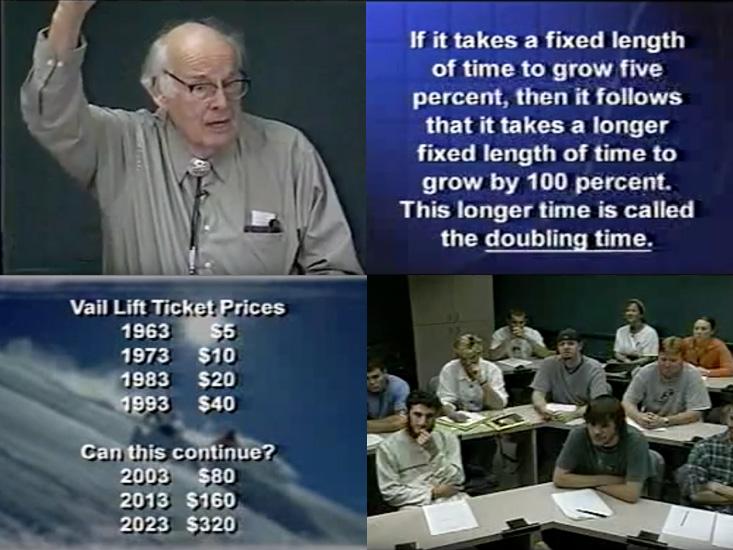
The physicist Bartlett, concerned with resource exhaustion, came up with a story of bacteria living in a Coke bottle. Imagine putting two bacteria in a soda bottle at 11 a.m. Assume the population doubles once every minute, and that by noon, the bottle is full. What time would it be before the bacteria-land politicians noticed that the population was running out of space? The answer is 11:59. After all, at 11:59, the bottle is still half empty! And what if the enterprising bacteria decide to drill for bottles offshore, and bring back three whole new empty bottles! How much time does that give the bacteria? Two more minutes.
Cole_BR-video
doubling time: Albert Bartlett’s Youtube video about the difficulties of understanding exponential growth has been seen over 5 million times. Vail lift ticket prices, one of his examples, continue to grow exponentially.YouTube

In an uncanny case of “science is stranger than fiction,” it appears that real-life bacteria took lessons straight out of Bartlett’s story. That is, certain types of bacteria have developed the ability to cooperatively respond to their surroundings by using what is known as “quorum sensing.” When the bacteria reach a critical local density, they seemingly act in unison to send a signal—to glow with bioluminescence, for example, or start spewing toxic substances into our bodies that can make us very sick. The community knows when a big enough change in quantity has created a qualitatively different environment, even when individuals may not know.

Stories like these have more than mere narrative power. Following the strategy of the bacteria, perhaps social media can be used as a kind of quorum sensing, crowd-sourcing perception. It’s certainly a good way to know when a societal tipping point has been reached, and it makes rapid responses easier. Social media is also a great way to spread stories. A YouTube video of Bartlett telling his exponential growth story has been viewed 5 million times. Multiply that by a factor of even two shares with family and friends (like Bartlett’s bacteria) and you are looking at real impact.

Following the strategy of the bacteria, perhaps social media can be used as a kind of quorum sensing.

Media may already be helping us understand the economic scale changes happening in this country. The surprising success of Bernie Sanders has been propelled by online discussions of income inequality. Michael Konczal, a fellow with the Roosevelt Institute, points out that between 1980 and 2006, gross domestic product increased fivefold, while financial sector profits increased sixteenfold. Between 1984 and 2014, the increases have been fourfold and tenfold, respectively. At this rate, we could well be in for a black hole-sized phase change.

Even billionaires know something qualitatively new is going on here—something so different that the old rules don’t apply. “I’m scared,” wrote Peter Georgescu, chairman of advertising giant Young and Rubicam, in The New York Times recently, speaking of the income gap. “We risk losing the capitalist engine that brought us great economic success.” His billionaire friends are scared too, he said. They know what we’re seeing is not just more of the same.

Could a tipping point exist where a concentrated quantity of power and money really change society? Even individual behavior? The evidence is mounting. One sociological study showed that drivers of more expensive cars are less likely to stop for pedestrians than drivers of less expensive cars. Nobel laureate in economics Daniel Kahneman points to studies suggesting that “living in a culture that surrounds us with reminders of money may shape our behavior and our attitudes in ways that we do not know about and of which we may not be proud.”

Cole_BR-artwork-REV

We do have a way to “see it coming,” whether it’s environmental tipping points or financial ones. It’s science. The whole point of science is to penetrate the fog of human senses, including common sense. Ingenious experiments and elegant equations act as extensions of senses that allow us to see farther and more precisely—beyond the horizons of what we think we know. Calculations predict possible futures, find clear signals in the almost constant noise.

Science predicted that massive stars would implode, nuclear bombs would explode, and humans could well destroy their own habitat (if they didn’t begin to take seriously problems like overpopulation and resource depletion).

Sometimes science requires us to accept the unacceptable, certainly the unpalatable: What? Drive smaller cars? Give up my lawn? Be satisfied with a small house?

It’s not always fun to see what’s coming, especially when easy solutions are nowhere in sight. It takes courage to admit we’ve been clueless.

Then again, we really have no choice. Bartlett called people who refused to accept they lived in a closed off Coke-bottle-like world the “flat earth society”—because on a flat earth, space could be infinite. There’d be endless amounts of land for farming or garbage dumps, endless supplies of water and fuel, no limit to the amount of toxins we could pump into an infinite atmosphere.

Alas, we live on a sphere. Eratosthenes figured this out thousands of years ago, and no one liked it much then either. But he certainly saw it coming.

A professor at USC’s Annenberg School of Communication, K.C. Cole is the author of the best-seller The Universe and the Teacup: The Mathematics of Truth and Beauty, and most recently Something Incredibly Wonderful Happens: Frank Oppenheimer and his Astonishing Exploratorium.

Toolification–Methodology

Reading Kuntz, chapter 3-4.

On page 66, the bit about microscope inspired me to think how tools defined the early man. This is an interesting direction to pursue–timeline, of course, is definitely at odds with Kuntz’s criticism of time and space as being stable entities. Would make a good satirical piece, though.

What makes me curious is how toolification until this chapter was the symptom of neoliberal academia, but is it?

I continue to question the topic of neoliberal rationslism as the reason for all that is not right and well with our scholarship and education.

The industrial age began because technological advance–tools were invented and became the condition for progress.

Methodologists: who needs them? A TQR Conference reflection

This was my first conference ever. The “Methodolosts: Who needs them?” presentation was my first and only session I was able to attend. It was an excellent experience, and I am glad I made it.

Methodologists… who needs them? The title meant to stimulate thought and to incite a debate. It accomplished both. People argued and framed the discussion around another question: What is the purpose of research? Is it about answering the research questions, or about asking them? If we can answer that, then we can answer who methodologists are and maybe even figure out who needs them

In me, the presentation stirred up pride: as one of the USF tribesmen, I was thrilled to see so many people come hear what the leaders of my qualitative clan had to say. I loved the tour into their thinking headquarters and appreciated the invitation to think with them. I could not be more pleased!

Yet, I also felt like a homeowner who discovered cracks on the stucco and opened her eyes to the reality of a possible sinkhole. I WANT to be a methodologist, but the ground on which this vision stands is apparently shaky, and so I felt frustration, and a fear of uncertainty for my future.

I know some people in the room were just as conflicted about their thoughts on the matter. Others immediately picked a camp. On the drive back, my co-presenters and I reflected on the experience and even argued a little bit. One student expressed her discomfort with the presentation because it brought USF’s dirty laundry out for everyone to see. It made her feel vulnerable and irate. I disagree–transparency in education is important.

I am still reflecting.

Thirty years ago, my 4th grade teacher called me a “class advocate” for sticking up for troublemakers. This was not meant as a compliment. Ten years ago, a very close friend called me a contrarian, and I agree–I love a good debate. Yet, as my husband frequently points out, I like to argue both sides. He finds it frustrating; I, on the other hand,  believe this is how I make sense of things. Some people argue to prove they are right. To them, having a winning opinion is important. I argue because the process helps me to organize information retrieval, to weigh facts, and eventually to arrive at a conclusion or another argument. I could care less whether I prove anything to my opponents: opponents are just helpers, anyway. Of course I like being right, but I enjoy the process of sense-making even more. I am no advocate, I am a discoverer. So how does this relate to the question of who needs methodologists?

Well, I argued every side I could come up with. I enjoyed the stimulation. I also loved the chance to demonize our neo-liberal education and the conditions it creates (it appears I am more of a socialist than I think. Oh wait. I was actually born and bred one, although I cannot say I hate the capitalism entirely–otherwise, why am I here, in the U.S.? Sigh…clearly, it is complicated.) I loved playing “find the label” because it is an exercise in identification of ideological oppression and a chance to analyze linguistic phenomena (I am thinking Derrida).

Then I read this article and it occurred to me I do not have to be a social microbiologist all the time. Apparently, astronomers get to have fun, too! In fact, swapping a microscope for a telescope sounds like a welcome change of a perspective. From humans to aliens, just like that…

Conclusion:
I sense the question “who needs them?” promotes the neo-liberal order because it is built using the language of demand and supply. This certainly explains Manning’s shift from major to minor (gesture) I felt while contemplating the topic. It soured my inquiry with fear, and I did not care for the shift.
…or maybe the person who suggested that methodologists know whether they are methodologists was correct? I wonder… perhaps, for many of us this presentation was about an identity crisis rather than the utility and purpose of research, as Johnny Saldana had me believe at first. Is it appropriate, then, to conclude that our post-presentation exchange in the room was the product of a generational (in academic, not chronological sense) divide?

So much to ponder, so little time…


Eddie and clothes

I tried my first round of wardrobe interviews with Becky over 7 months ago.

I also interviewed Eddie (2 interviews), though his explanations into his wardrobe were less dramatic and revealing. I gained some insights, though. Then I put these on hold and let everything compost. Slow Ontology style.

It has been months, but Wardrobe interviews have not gone away too far. They are always somewhere nearby… I cannot put my finger on what it is that is trying to come out yet, but I find myself primed to the topic. For example, I met a resource officer from Danny’s school at the movie theater and she was unrecognizable–talkative, smiling, friendly, connected–I took note that maybe her uniform made her perform her “resource officer” identity because out of her uniform, she was almost a different person! I really want to speak with a couple of officers about life, work, purpose, laws, education…

Today husband showed me an old (taken 4 years ago) video from our trip to Russia. Little Ed was 10, Danny just turned two. In the video, they are running around at night on the Red Square–all lit, beautiful, sparkly, historically and personally significant landmark, and yet, Eddie’s first comment was “I loved that Old Navy sweatshirt! I wonder what happened to it…” A few seconds later  he made a comment about his green sneakers “I ran those to the ground later in the year!” Clearly, clothes were an important piece, even a space in time processed and labeled in his mind as a “childhood memory.” His “childhood” identity in that video was a reference point for his now, how he perceives himself in the present.

I really want to dog into this deeper.

Coming to Postqual

I consider myself fortunate: unlike numerous other researchers, I had the privilege of taking a “formal” Postqualitative Inquiry course. Those who dabble in postqual came to it on their own.

I am also fortunate because I am a mother of three, a wife, an immigrant, and also a graduate student. Research questions are around me. I never lack ideas for research. Those that make to the surface and are fortunate enough to stand out, make to the next level where they compete with one another, evolve, and ideally, find their way to the pages of my research journal. More often then not, they fizzle out by the time the long pickup line at my son’s school is over. I noticed many of my ideas do not get completely forgotten. They echo and come back to the surface of consciousness in no particular order or pattern and remind me of multiplicities.

At some point, I decided to assemble a few short thought experiments and musings into a book. I envisioned the assemblage as a primer for students new to Postqual.  Of course the idea of a primer reinforces the  method,  a method of instruction in this case, and method, of course, is at odds with the very idea of postqualitative inquiry.  Nevertheless, I did it because I recalled my own struggles with breaking away from the logic behind the more conventional research methods.

I first engaged with postqual in Qualitative Inquiry II class, a year before postqualitative. The word “postqualitative” was never uttered; yet, the course was built around Jackson and Mazzei’s “Thinking With Theory in Qualitative Research.” We went through the chapters sequentially, one by one–Derrida, Spivak, Foucault, Butler, Deleuze, Barad… I thoroughly enjoyed the readings and my professor Dr. Richards, who let me experiment with the format of our weekly class assignment. I dusted off my husband’s huge, long-forgotten set of Prizmacolor pencils and sketched; I put together collages that documented my thought. I had no trouble with the concept of “plugging in” and the theory. In the same class, I experimented with autoethnography and wrote several short excerpts about mother my autistic daughter. I wrestled with painful issues–who I am as a mother and what does it mean to be a good one. I thought about normality and how my daughter and we as a family perceive it. I have made amazing discoveries and deconstructed personal ideas about research and researchers. Somewhere toward the end, I talked to Jenni who pointed out in passing that poststructuralist thought seeks to decenter the human. This struck me like lightning in the clear sky–the entire semester I labored under the thought that qualitative research is all about humanity. How then, do poststructuralist theories fit in my conclusions? I obviously did it all wrong, but somehow, it did not feel like a disaster. That summer, I wrote a lot in my researcher/journal blog and read half of Foucault’s “Madness and Civilization.” In the fall, I took Arts Based Research class and struggled with the very concept of research, particularly, with its purpose. I wondered what counts as data and how can art possibly pass for research. Then I started reading Manning’s The Minor Gesture and came across

Politics, Neoliberal academy, and, and, and

I have been trying to stay away from politics, but it is a difficult thing to do–they sip through interactions with others. I hate it because it demands of me a political stance, and I resist it because I know the world is much more complicated than that. I could care less where I stand–I have become wary of choosing packs and having to conform to the conventions, expectations, and rules that come with its membership. I tried belonging–grew up as a Soviet, then later, I was a Christian; enough said–I do not like memberships.

…I am not a troublemaker, I am simply curious. And now, way beyond my passionate twenties, I no longer want to change the world–I just want to make it better, help everyone co-exist, find ways for everyone to get along and thrive somehow. Yet, Trump’s election broke me–I became so emotionally invested that the night Trump won, I felt dead. Specifically, what died was the part that believed in human’s virtue, respected opposing points of view. In its wake, I felt disgust, disbelief, disappointment with other fellow humans, and anger.  With time, the pain had subsided, but not the disgust, nor the constant awareness of my ethically problematic position as a Russian national and a permanent resident of the United States. Once again, I feel like I am forced to choose camps, and I refuse to do it.

When I became aware of the term “neoliberal academy” about a year ago, I knew in which camp I belong. My enculturation into the academic persona was easy–I am easily persuaded and sensitive to the affective power of the written word, and academic literature is no exception. When I read, I always search for the protagonists, the antagonists, for stances, philosophies, messages, and so forth; I like to know where I step next.

Neoliberal is bad. The principle of parsimony is impotent. Complexity and ambiguity are the answer. If I had a bow, I’d slap it on this neat package and put it on display to enjoy it.

Today, I question the evilness of neoliberal. What would my world, my time look like without the efficiency, the productivity of the neoliberal paradigm? Would I be able to reconcile my yearning for a simpler life on a small farm with my desire to be a part of bustling city life, the modern conveniences and comforts afforded by financial security? How do I work out the gravitational pull of adventure and cultural explorations through food and long-distance travel while I worry about the pollution I create when I fly or drive, or enjoy imported foods? I am as much a product of the environment as the producer of the environment. I am a phenomenon, and so is the neoliberal order, and the ecologies, and the species, and all the things, concepts, and events that I hate, love, or constantly interrogate in order to decide whether I should hate or love them.

I am entangled with politics and world orders, but I do not need to hate them, love them, or devote my life to changing or preserving them–I want to live in the moment, becoming with the world around me as it becomes with me. I do not want to be anxious about my employability after graduation–I want to stay curious and see where it takes us as a family.

Epistemology as clothes

In the beginning of postqual, I realized that my epistemologies change as I progress through the day and perform the numerous roles as a mother, a wife, a neighbor, a friend, a student, a daughter, and so forth. I have been “sitting” on this discovery for over a month and made it my own. I asserted this belief since then several times and even came up with a narrative: “If I were not a postpositivist in the kitchen, my family would go hungry. If I was not an interpretivist with my husband, I would be divorced. With my kids, I am a constructivist. I have to be!” and so forth… Today, while driving home, I thought that I should call myself on these assumptions so I thought of a study:

Method: progress through the day and take note of what type of knowledge I typically encounter and what epistemological beliefs help me process the information, and in what way. I will create a map, then try to create an outfit, a costume (or at the very least, a hat, or an accessory depending on how strong the belief is) to represent (constructivism? already?) each belief.

If clothes help construct our identities and are the material part in our performativity, then why not tap into the potential or wardrobe research?

Mentoring PostQual

“A clever, beautiful quote will go here. Some day.”

Unlike some authors of postqualitative genre, I am privileged–I am a doctoral student taking an inaugural course in Post Qualitative Inquiry. I have a proper instructor and a syllabus to nurture my inner post-structuralist, peers to validate Vygotsky and Piaget, a body of literature to roam, and three credit hours to justify reading and experimentation. I know Jenni had no such opportunity, and neither did (…).

Yet, perhaps, my greatest fortune is that I am getting acculturated into postqual before the two fontanelles of quantitative and qualitative thinking in my want-to-be-a-research-methodologist head had fused together to form a hard, thick, boney casing around my thoughts. Presently, I have nothing to lose as I have no idea when, where, or even whether I will hold an academic position, or even publish. Therefore, this piece, written from a student-stepping-into-postqual perspective, is a mixture of risk-free wonder, care-free play, and of defiant confusion. I offer you a glimpse into my train of thought as I pondered my options for the final project. It took place somewhere in the middle of the semester.

It began with a discussion of the final project on our second day of class. The tentative topic is Mentoring in PostQual. Lost in thought, I probably missed something. Why mentoring? We exchanged some ideas; a couple of students offered examples of mentoring relationships in their lives, and it was wonderful because I got a feel for what kind of people these new classmates of mine are, but the topic… the topic is meh. I am not excited about it. No, really, why mentoring? Clearly, Jenni is the mentor in the spotlight here, but why a mentor and not a teacher? This is a rhetorical question–I believe I know what she will answer; she likes to point out that she is not there to deposit knowledge into her students’ heads. …is this what she believes teaching is–depositing? Wait… this is my rendition of what Jenni thinks of teaching. How does Jenni define “teaching”…  Actually, she does not teach, she facilitates. Never mind, teaching is irrelevant because the topic is mentoring. Is she a mentor?  Why not a Sherpa, or a coach, or even a doula? I am resisting the impulse to explore the meaning of the word “mentor,” to operationally define “mentoring.” Much to my excitement, I realize that by refusing to go there, I skip over a pile of imaginary manure even as I preemptively reach for the shovel of Derrida’s linguistic differance and Spivak’s discourse on hierarchies. Oh, the cleverness of me! Is this the evidence of me becoming?

I set out into poststructuralism a year ago, while in my Qualitative II class, and since then, I have clearly grown. I walk around this pile of manure, look at it one last time, wondering what my definitions of “mentor” or “mentoring” might sound like if I give it more thought; but as soon as an answer threatens to form,  I run away with my nose pinched and enlightened: “an inquiry into mentoring in PostQual should not be about “What is mentoring;” otherwise, what am I doing in PostQual?!”

I remember the playful exchange we had during an earlier class–“How is […]? Where is […]?” The intentional disruption and absurdity of these questions made me laugh, and so I play along: if it is not “what is mentoring?” then it must be “where is mentoring?” or “how is mentoring?” because “why is mentoring” in the context of the classroom and instruction reeks of politics and of more manure. In fact, I would not even know what theorist to use to dig myself out of this one. Manning, perhaps?

I should press on just to see if I can turn the topic blahs into an opportunity for a methodological challenge.

A student of Educational Research, Measurement, and Evaluation, I dutifully take the inventory of my newest shiny set of PostQualitative tools: thinking with theory, writing in minor, tuning into minor shifts, thinking with concepts…  Thinking with a concept is my natural mode of existence. I recently became aware that I think in images and that these images create a movie as thoughts die off, develop, interact with memories, recalls, conversations with others, and so forth. Sometimes, the movie is blurry, in the background of my conversations; other times, the movie becomes vivid and sharp, positioned front and center. Concepts are visuals. I visualize concepts. It turns out, I cannot think WITHOUT concepts.

A year ago, in Qual 2, I read Jackson & Mazzei’s “Thinking with Theory” and in the first week, I experimented with the idea of “plugging in” thoughts into concepts. I dusted off my husband’s beautiful set of Prismacolor pencils and sketched to make sense of the process. I loved it. The activity opened my eyes to the world of “plugs” and reminded me of mushroom-picking. First, you do not see anything, you only know where to look for them: different mushrooms like different trees. Then suddenly, you see one, hidden under a leaf; then another, and another, then more, and more. You do not choose your path–the mushrooms lead you–and you can certainly get lost in the woods. The activity is exhilarating and somewhat torturous–it does not end once your basket is full, as one should expect–the mushrooms are still all around you, one is more gorgeous than the other. They taunt you and tempt you to make space in your basket by dumping the unimpressive specimens you settled for in the beginning, back when you did not know whether you will find any mushrooms at all. Conceptual plugs are my mushrooms, and it is a fitting analogy because I suddenly realize that mycelia are a perfect example of a rhizome. Deleuze and Guatarri’s rhizome.

Ideas. Concepts… they buzz, and chatter, and crowd my head. Where was I? Ah yes. I was searching for an acceptable conceptual plug for my “mentoring in PostQual” topic. Since I am still not “feeling it,” I have to force connections with the PostQual scholarship rhizome that grew for me this semester from my thinking and readings. I am a will-be-methodologist, damn it!

Because I am not yet feeling it, the plug does not feel organic, like a mushroom or mole tunnels. I need a more mechanic assemblage with solid, well-defined, and hopefully, breakable edges, like those found in quantitative methodology. I am thinking of measurement. Let’s see if the model fits: I need to identify my latent variable, the construct, then connect it to the carefully boxed in observed variables.  Yes, I am aware that “construct” and “concept” are not the same things, and no, I am not going to apologize for using these terms interchangeably because in PpostQual, I claim my right to experiment, play, stretch, and abstract whatever I wish. So all I need to do is identify my observed variables, complete the model, and test the “plug.”

I am amused to see the quantitative idea of modeling grow soft and lose its hard shape in my PostQualitative play; it reminds me of Dali’s infamous melting clocks. Measurement is still valid, but hardly recognizable. It is still measurement, but in Deleuze and Guattari’s terms: “Stratometers, deleometers, BwO units of density, BwO units of convergence” (Deluze and Guattari, 1987, p. 4).

Here, I can illustrate. See figure 1, or better yet, figure 2.

I wonder if this is what truly mixed method could be–quantitative and qualitative methodologies mixed like a cocktail, not like a bar trail mix. I should stash the idea into my PostQual methodological toolbox, or rather my new anti-Methodological un(-tool)box.

It is time to plant a stick in the mud and think about mentoring. Jenni suggested the “stick in the mud” method to me today after I confessed that I am becoming way too fast to produce anything for a publication. Alas, all I have is fragments–reflections, notes, comments, mental images and video clips–the artifacts that fall into my wagon as I keep accelerating through and toward the unknown plateaus.

So what of the melting model of mentoring in PostQual? At this moment, I see it is a reflective model, the one where the latent variable(s) is/are said to cause the observed variables.

If the latent construct is “mentoring,” then my immediately obvious observed variables caused by mentoring are 1) growth in academic confidence; 2) intellectual growth; 3) academic acculturation. The more I reflect on each, the more I consider how much they are entwined, and so I must indicate that they correlate. I also became interested in mycology, rekindled my love of gardening and thing-making, and developed a kinder opinion of pigeons. Most important, perhaps, I found the experience of playing in PostQual therapeutic as for the first time in my life, I finally felt validated in my life-long propensity to live slowly. I like to walk fast, but I always think and I work–in every iteration of this word–slowly. Where in my model does this batch of observations fit?

The model is starting to look entangled: Jenni infected me with Manning’s “Minor Gesture” months before this semester, so I came to class armed with the vocabulary and a small working arsenal of PostQual concepts. I was also familiar with Thinking With Theory and therefore, felt confident from day one. On the other hand, Jenni challenged me–knowingly or unknowingly–to read beyond our syllabus and humored my consistently delighted reviews of these detours. I used these readings as my intellectual fuel or better yet, food,–and so I grew. As I grew intellectually, I also grew in confidence.

My reading detours virtually introduced me to the PostQual pantheon, the abstracted, mythical bodies whose names keep appearing and reappearing in journal articles, books, and our class discussion. Clearly, they have names, but also (probably, though not necessarily) faces and voices. They probably eat, drink, and sleep, laugh and shout when they get angry. They probably shop. I know that some of them go for walks and talk to animals. They are the assumed material bodies filling the void in the absence of their physical bodies. I imagine these scholars because their written words broadcast connections. These connections send me zig-zagging until I start to feel more familiar with some, but not the others. The growing familiarity helped make PostQualitative ideas less abstract, and when Jenni brought in our guest speakers whom I already knew and admired through the readings, I felt the kinship. The feeling of kinship led me to believe I have finally found my tribe, especially once I realized how familiar I have become with its language and its tradition to avoid traditions. I have been acculturated. Further, the effects of these big three variables that I now recognize to be the result of Jenni’s mentorship (whatever mentorship means–I still refuse to step there) created the entry point into the thinking of the material–the pigeons, the mushrooms, my garden, the numerous versions of cats, clocks, cameras and phones, pizza, snacks, beer, and bagels, things I made or consider making. I am plugged into a multiplicity that no longer fits on the page that holds my model, the multiplicity that exists above the surface only as shadows and fog in quantitative and conventional qualitative epistemological frameworks. It is ever changing; it grows as I grow. It is replete with holes, entry points, and cuts. I can enter it any time and anywhere I please, and I definitely please.

As I step further and further away from my pretentiously orderly, yet pregnant model, I think of mentorship in PostQual in terms of affects, or better yet as a chain of affects (Deluze and Guattari, 1987, p. 30). I also think of how grateful I am, just as Susan

.


remember


Saldana’s litmus test. Color


Why thank you notes? When I came to the States, I was not familiar with the concept of a thank you note. It was not a part of my culture. In Russia, we expressed our gratitude verbally, and I was amused why the Americans felt they had to express the gratitude in writing, and in prefabricated cards as well. I thought it was a strange custom, and I attributed it to economical/ marketing climate. I had a traumatic experience related to that, and it was a part of my culture shock. If epistemologies are vehicles/by-products/results of enculturation, then it is appropriate that I use thank you notes as artifacts of my enculturation.

“Dear Jenni, thank you for everything you have already done for me as a mentor, and what you are still going to do for me and with me. A more pressing thank you, however, is for providing this enabling constraint–thinking about mentoring in qual for my final project (and asking to make it fit on two pages. Huh!)

Geological nature of autism research

Today, I “accidentally” came across an article by Marcelina Piotrowski “Writing in Cramped Spaces” (2017). Jenni had posted several other articles from the special issue of Reconceptualizing Educational Research Methodology, 8(3) in the module “Doing PostQual I” and I became intrigued by the other articles in the roster.

Piotrowski’s writing is thorough, very well documented and organized. She is talking about cramped spaces and links medicine, literature, geography, ecology, art, and philosophy to  explain postqual and intersciplinary research. By doing so, she actually illustrated the concept with her own writing. On the highlighting index, this article received the brightest, most highlighted marks.

This read came at an excellent time–I struggled to start writing the lit review for our first POI study publication, and Piotrowski’s work helped me on two fronts: she began her writing with the discussion of disciplinary research–a direct hook to POI study, and explained why writing can become problematic. I  feel better, I can try putting that lit review together.  A post from earlier today captures some of my struggles as I try to figure out  how I am getting lost in exploration of the wildnerness of postqual and methological, political, and cultural dilemmas of educational research and yet, hearing my mom call me to dinner from three feet away. Of course I am having all these epistemological adventures in my head, without leaving the backyard!

Anyway, at the end of the article, when Piotrowski started pulling in ecology as an illustration of ecology as emploed by  Guattari, I thought about using geology and archeology to write about autsim. Autism is a multidisciplinary concept, but somehow, it is very much territorialized within each discipline. If you assemble all the plains of research together, you will end up with a very crude sculpture of Autism. I want to see if I can dig up some archeological artifacts buried in layers of sediment of research produced by multiple fields and their epistemological traditions. It would be cool to do a postqual meta analysis of autism research. Map it, take it apart. See at what point the division in to high and low autism came to be. The DSM wars, the methodologies used. It would be neat to take on geology or archeology as a guide because sediments are formed by the climate, geological, and biological activities. So I can at least map the climate of the culture, scientific methodological rock samples, and play with it some more to develop my methodology of inquiry as a parallel to geological and archeological research. I could do a survey of literature by year of publication. Tons of work, but maybe well worth it.

Mixed and Mixology

I cannot get out of my head the recent round of interviews my department conducted for two new openings–one for the mixed method position, the other for quant. In a way, the event has made an impression on me…It brought the sense of urgency and with it the potential of generative anxiety, the good kind that motivates. Dr. Dedrick kept offering little comments on the process–receiving nearly a hundred of applications to finally narrowing the search down to a handful of candidates, arranging for the final interviews, flying the finalists in, showing them around, meeting the faculty, administrators, and students… I wonder if someone enjoys this… I panic just thinking about how one day I may be in this position… mixed methods would be amazing…

And then I think about how I fell in love with research methods when I took my first RM class as psych undergrad, then the second… they were quant classes, too. At USF, I discovered qualitative and philosophy. How I have grown. This semester I am taking advance measurement class, single case experiments class, and a post qual class, and all I can think about how different and yet, the same they seem. At least qual does not pretend that the researcher is not a crucial part of the study. Subjectivity is a feature, not a condition that needs to be kept in check… Last night Dr. Ferron explained the essence of the statistical approach to analysis in such easy, palatable terms (both Dedrick and Ferron do that–they make quantitative methods friendly somehow, not so sterile) that I must question why do we have so many purists in research methods? Of course, it is a rhetorical question–there is a great deal of culture in academic training among other things.

In stats, we compare our observed scores to theoretical curves to prove or to disprove our null hypotheses. We design our studies using the logic tied to assumptions of normality, homogeneity of variance, independence… then there is a neverending tug of war between type I and type II errors that must be balanced well enough to convince the others who (also thanks to their training) only loosely (empirically or theoretically, or somewhere in between) agree on thresholds between statistically significant and not significant  results. And what of the general convention of 0.05 alpha? Arbitrary, but widely accepted. The data conceived, then collected, then analyzed as a model–observed scores, true scores… some of the concepts are “squishy” (in Dr. Dedrick’s own words).

It is ALL so damn squishy!

Barad’s application of quantum physics acknowledges and celebrates the squishiness. I like it. So as I think about “mixed methods” designs, they are just like a trail mix–the chunks that never quite blend together. Within most designs, quant and qual carefully observe their methodological boundaries. The methodologies are preserved and limited by conventions and traditions that decide what a researcher can and cannot do. Researchers are obliged to stick with conventions or else be scrutinized in terms of rigor, validity, integrity. They must be bold enough to answer methodological examination from BOTH qualitatively and quantitatively oriented peers. The risks are obvious. But what of risks? RISK is a construct, it does not have to be a variable or a sure limitation of research. Does it? Just think: risk, too, is a highly subjective term. It is socially constructed, much like validity, objectivity, and other measures that weigh a study and pronounce its value. So what if it is dealt with reflexively? I have nothing yet, just an abstract vision (which is yet, somehow, seems solidified) of my future employment as a methodologist.

I should totally try and conceive MIXED methodology designs as a cocktail, liquid and blended, not mixed like the trail mix.

So what if I do a single case experiment but analyze it qualitatively AND quantitatively?